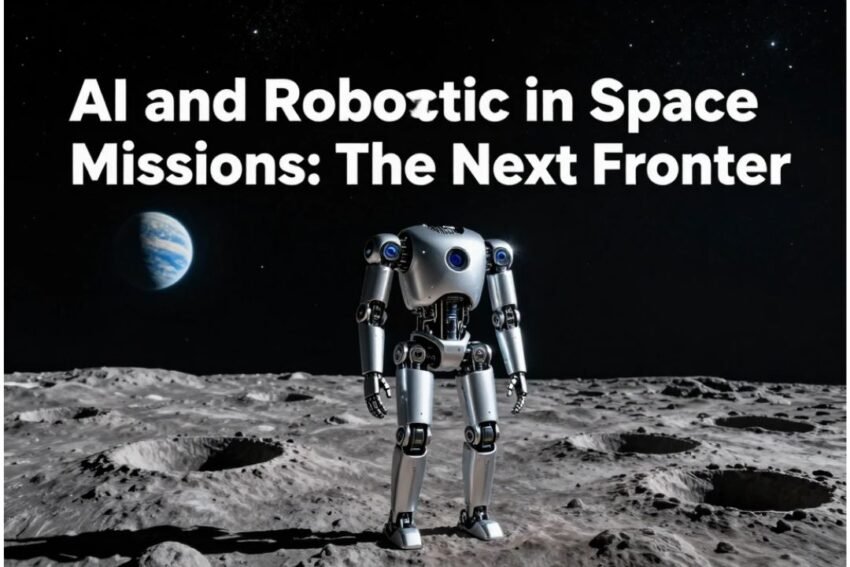
Artificial intelligence (AI) and robotics are transforming space exploration into a more autonomous, efficient, and scalable endeavor. As missions extend farther from Earth and grow more complex, human control alone becomes impractical. AI‑powered robotics — combining machine learning, autonomous navigation, decision‑making, and advanced mechanical systems — are now essential for future space missions, from the International Space Station (ISS) and lunar outposts to deep‑space rovers exploring Mars and beyond.
🚀 Why AI and Robotics Matter in Space
Space environments are extreme: vast distances create communication delays, harsh conditions threaten human safety, and unknown terrain requires fast, intelligent responses. AI and robotics help overcome these challenges by enabling spacecraft and robots to operate independently, intelligently, and safely without constant Earth‑based input.
For example, NASA’s autonomous systems are no longer just data‑processing tools — they are becoming co‑pilots capable of planning missions, navigating terrain, and making real‑time decisions.
🤖 1. Autonomous Navigation and Decision‑Making
One of the most significant breakthroughs in recent years has been the application of AI to autonomous navigation in space:
- NASA’s Perseverance Mars rover completed its first ever AI‑planned driving route on Mars, in which generative AI analyzed terrain and planned safe paths without human planners guiding every step — a crucial step given the long communication delays between Earth and Mars.
- AI systems now help rovers and landers evaluate hazards, avoid obstacles, and optimize travel routes on distant planetary surfaces, increasing mission efficiency and science return.
Autonomous navigation lets robots respond to their environment in real time — a necessity for deep‑space missions where Earth‑based instructions are delayed or even impossible.
🛰️ 2. Robotic Support on Space Stations and Orbit
Robots are now working alongside astronauts on orbiting platforms like the International Space Station (ISS):
- NASA’s free‑flying robotic assistants, called Astrobees, have been used for autonomous operations — and recent experiments showed machine learning models guiding robots safely and significantly faster through complex ISS environments than traditional methods.
- A recent test aboard the ISS demonstrated AI‑assisted autonomous navigation that is 50–60 % faster than conventional robot planning approaches, marking a major step toward robots performing routine tasks with minimal human oversight.
These AI‑controlled robotic systems can handle supply transfers, environmental inspection, and even maintenance tasks — freeing up human crew time for higher‑priority scientific work.
🛰️ 3. Robotic Construction, Maintenance, and Assembly
Future missions to the Moon and Mars will require infrastructure — habitats, power systems, communication networks — built long before human arrival. AI robotics are key to this:
- Robotics companies like GITAI are demonstrating autonomous robots that can build communication towers and infrastructure in simulated lunar and Martian conditions, a precursor to independent construction on other worlds.
- These robots combine AI with advanced manipulation systems to perform tasks hazardous or impractical for humans, such as welding, assembly, and equipment installation.
Using autonomous systems for construction not only reduces risk but can dramatically cut costs and mission time compared with human‑led extravehicular activities (EVAs).
🧠 4. Intelligent Scientific Discovery
AI goes beyond navigation and mechanics — it helps spacecraft think about science:
- NASA and ESA use AI to analyze vast volumes of scientific data collected by satellites, rovers, and probes, helping identify features of interest, prioritize targets, and even suggest new observations.
- Autonomous science systems like AEGIS (Autonomous Exploration for Gathering Increased Science) allow robots to select and investigate scientifically interesting targets without waiting for Earth commands.
This ability to make science decisions onboard accelerates discovery and maximizes the efficiency of expensive space missions.
🪐 5. Preparing for Human‑Robot Collaboration
As missions push toward deeper space — the Moon, Mars, asteroids — humans and machines must work together seamlessly:
- AI robotics relieve astronauts of routine and dangerous tasks, allowing human crew members to focus on higher‑level decision‑making and mission control.
- Future systems will include advanced humanoid and multi‑agent collaborative robots capable of anticipating human needs and working collaboratively on complex mission objectives.
Efforts are also underway to create frameworks like Agent Mars, a simulated multi‑agent system designed for coordinated actions across humans, robots, and autonomous digital services in multi‑planetary missions.
🚀 6. Overcoming Deep‑Space Challenges
Communication delays — such as the 20‑minute lag to Mars — make remote control impractical. AI and robotics are essential for missions where immediate decision‑making is required but Earth‑based control is too distant:
- Space AI systems can detect issues, react to anomalies, or pivot tasks on their own — a capability vital for risk‑reduced exploration of remote asteroids, moons, and planetary bodies.
- Future exploration missions will embed AI autonomy deeply into lander and orbiter decision processes to ensure mission success in environments too distant or harsh for direct human intervention.
🛰️ 7. Expanding the Scope of Space Robotics
Beyond planetary rovers and station assistants, AI robotics are poised to tackle new frontiers:
- Autonomous robots may someday build orbital infrastructure — from space telescopes to self‑assembling data centers — using autonomous assembly and AI planning.
- AI and robotics will enable in‑situ resource utilization (ISRU) — such as mining, processing, and manufacturing with materials found on the Moon or asteroids — supporting longer human missions and sustainable colonies.
Ultimately, AI and robotics will be central to the next era of space habitation and commercialization.
🌟 The Future Is Autonomous
The integration of AI and robotics in space missions represents a paradigm shift — missions are no longer executed from Earth but increasingly on‑site, in real time, with machines acting as explorers, collaborators, and builders. From autonomous navigation and construction to scientific discovery and long‑distance exploration, these technologies are the backbone of future space efforts.
As research and real in‑orbit demonstrations continue to succeed, AI and robotics will not just assist human explorers — they will lead the charge into the most challenging and distant corners of our solar system.